
Search: cavalier/info-lgs@agrotis.it – Page 8

Need a new search?

If you didn't find what you were looking for, try a new search!

Maternity Verification – Pigeon

This product includes maternity verification and DNA profiling of the offspring. If the DNA profile of the (expected) mother is unavailable, a separate DNA profile needs to be ordered.

A DNA profile is established using DNA markers. The profile from each sample is stored in a database and can be represented as a barcode, which is unique to each individual. This DNA profile serves the purpose of parentage verification, involving a comparison of the genetic information present in an offspring with that of the potential parents. For accurate parentage verification, all genetic information in the offspring must be traceable to the combination of the dam and the sire. In the majority of cases, the reliability of this analysis exceeds 99.5 percent.
Parentage Verification – Pigeon

This product includes parentage verification and DNA profiling of the offspring. If the DNA profile of the (expected) parent(s) is unavailable, a separate DNA profile needs to be ordered.

A DNA profile is established using DNA markers. The profile from each sample is stored in a database and can be represented as a barcode, which is unique to each individual. This DNA profile serves the purpose of parentage verification, involving a comparison of the genetic information present in an offspring with that of the potential parents. For accurate parentage verification, all genetic information in the offspring must be traceable to the combination of the dam and the sire. In the majority of cases, the reliability of this analysis exceeds 99.5 percent.

Paternity Verification – Pigeon

This product includes paternity verification and DNA profiling of the offspring. If the DNA profile of the (expected) father is unavailable, a separate DNA profile needs to be ordered.

A DNA profile is established using DNA markers. The profile from each sample is stored in a database and can be represented as a barcode, which is unique to each individual. This DNA profile serves the purpose of parentage verification, involving a comparison of the genetic information present in an offspring with that of the potential parents. For accurate parentage verification, all genetic information in the offspring must be traceable to the combination of the dam and the sire. In the majority of cases, the reliability of this analysis exceeds 99.5 percent.

CombiBreed Chinois à crête

Ce pack combiné est conçu pour vous fournir des informations essentielles sur la santé génétique, les traits et la diversité de votre chien, et comprend des tests ADN pour de nombreuses maladies et/ou traits importants. De plus, nous calculons également le coefficient de consanguinité (COI) et le pourcentage d’hétérozygosité de l’ADN de votre chien. Le COI indique le degré de consanguinité de votre chien, tandis que le pourcentage d’hétérozygotie mesure la diversité génétique individuelle de votre chien.

Les informations sur les tests individuels de ce dossier sont disponibles dans la section « Tests inclus » sur cette page. Nous acceptons des échantillons d’animaux de tout âge. Normalement, le délai de traitement des tests effectués dans nos propres installations est de 10 jours ouvrables après la réception de l’échantillon. Pour les tests externalisés, appelés « laboratoire externe » ou « laboratoire de brevets externe », le délai de traitement est d’au moins 20 jours ouvrables après la réception de votre échantillon. Veuillez noter que les 20 jours ouvrables mentionnés constituent une estimation, car le délai d’expédition vers ces laboratoires externes ou installations brevetées peut varier en raison de retards inattendus.

Certains tests inclus sont réalisés par un laboratoire externe. CombiBreed s’occupe de la négociation entre vous en tant que client et le laboratoire externe. Dans ces cas, CombiBreed ne peut pas être tenu responsable du comportement du client et/ou de l’entrepreneur.

Parentage Verification using microsatellites (STRS)

STR yes
STR no

The genetic variation which is present in an animal, originates from both parents. Half of the variation is originating from the father, whereas the other half comes from the mother.

For parentage verification, typically 20 up to 40 genetic characteristics are visualized. In this process the length of genetic fragments is being measured. The measured length of a genetic characteristic in an offspring must correspond to the length in the mother and father that were provided for comparison. In two examples, it is shown how the basic rules are applied in parentage verification.

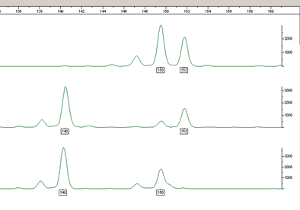
In the figure an example is provided of a correct parentage. In this figure, the DNA is shown of three individuals: an offspring (upper line), a potential mother (middle line), and a potential father (bottom line). In each line one genetic marker is shown. Two DNA fragments are visible as peaks. The first fragment of the offspring is originating from the father (length of the fragment is 150), whereas the second fragment comes from the mother (fragment length 152). In this case both fragments of the offspring are present in the parents: the parentage is correct.

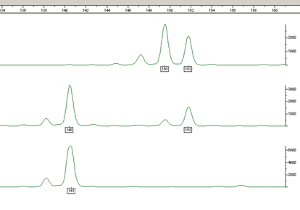
In the second example a situation is shown where parentage does not qualify. The three lines are shown in the order of offspring, potential mother and potential father. Again in each line one DNA marker is shown, where two DNA fragments are visible as peaks. The second fragment of the offspring is present in the mother (fragment length 152), whereas the first fragment in the offspring (fragment length 150) is NOT present at the assigned father. In this case, one fragment is present at the offspring, which is not present in either of the parents: the parentage does not qualify.

When 20 up to 40 different genetic fragments are checked, the chance that an incorrect parentage is not detected becomes very small. The genetic fragments which are used for parentage verification and identification provide no information on properties such as color and quality of an animal, plant or human, since the fragments are non-coding.

When the length of a number of DNA fragments is measured for a sample, a DNA-profile is established. This pattern is unique for a specific individual person, animal or plant, so that in cases of doubt DNA-profiles can be compared to confirm if two samples originate from the same individual.

Coat Colour Gold (Copper, Sunshine, Extreme Sunshine)

In British Shorthair and Siberian cats, the Gold phenotype is a colour modification of a typical striped tabby coat, lightening it to shades of yellow and orange. The phenotype can be caused by one of several different mutations to the Corin serine peptidatse (CORIN) gene: Sunshine, Extreme Sunshine and Copper.
The three ‘Golden’ mutations are included in this DNA test. Information on the individual tests is available through the links at the DNA tests.

Pyruvate Kinase Deficiency (PKDef) – Beagle

L’insuffisance de kinase de pyruvate (PKD) est provoquée par une mutation dans le gène de PKLR. En raison de cette mutation une enzyme importante dans la voie de kinase de pyruvate est affectée et ne peut pas produire assez d’ATP. La pénurie d’ATP conduit à la lyse des érythrocytes, ce qui conduit à une anémie hémolytique régénératrice sévère.

D-Locus (Dilution)

The dilute gene (MLPH gene) is responsible for the intensity of the coat colour by affecting the amount of pigments in the hair shaft. This gene is also known as the D-locus and dilutes all colours. The Coat Colour Dilution test (K760) tests for the genetic status of the D-locus. The D-locus has two variants (alleles). The allele D is dominant and does not have an effect on the coat colour. Only when the cat has two copies of the recessive allele d the coat colour is diluted. The dilution of black results in grey, called blue by cat breeders. Chocolate/brown dilutes into lilac, it is described as dove or light taupe gray, and is sometimes called frost or lavender. Cinnamon dilutes into Fawn, it is described as “coffee and cream” or caramel color. Some cat breeds are fixed for one of the alleles. The Egyptian Mau and Singapura are fixed for the dominant allele D. The breeds Chartreux, Korat and Russian Blue are fixed for the recessive allele d. Most other breeds can have both alleles.

The Coat Colour Dilution test encloses the following results, in this scheme the results of the Coat Colour Dilution test are shown in combination with the possible results for the B-locus):

D-locus

B-locus

Coat Colour

D/D

B/B, B/b or B/b’

Black

D/D

b/b or b/b’

Brown, chocolate

D/D

b’/b’

Cinnamon, Red

D/d

B/B, B/b or B/b’

Black

D/d

b/b or b/b’

Brown, chocolate

D/d

b’/b’

Cinnamon, Red

d/d

B/B, B/b or B/b’

Blue

d/d

b/b or b/b’

Lilac

d/d

b’/b’

Fawn

Lundehund syndrome – LS

The Lundehund breed is predisposed to Lundehund Syndrome (LS), a unique gastro-intestinal disease. Lundehund Syndrome varies in severity, ranging from minor recurrent diarrhea to severe inflammation resulting in death or necessitating euthanasia on humane grounds. It can be partially treated with anti-inflammatory drugs, specialized diets and vitamin supplements.

While the precise cause of the disease is still being studied, it is in part associated with a recessive defect to the gene P3H2 (also known as LEPREL1).

Spondylocostal Dysostosis (Comma Defect)

Spondylocostal Dysostosis (Comma Defect) is a severe skeletal growth disorder that results in a shortened body and an abnormal ribs and spine. This variant of the disorder, also called Comma Defect due to the abnormal body shape it causes in affected puppies, occurs in the Standard Schnauzer and Miniature Schnauzer. Comma Defect is lethal, resulting in stillbirth or death shortly after the puppy’s birth. It is caused by a recessive mutation to the gene HES7.

Glanzmann’s Thrombasthenia (GT) 1 – Horse

Glanzmann Thrombasthenia (GT) is a bleeding disorder caused by defective platelets, which results in an inability for blood to clot properly. This variant of the disease, found in the Quarter Horse and Peruvian Paso, is caused by a recessive mutation to the gene ITGA2B. A related variant is also found in the Quarter Horse, as well as the Thoroughbred.

Muscular Dystrophy (MD) – Corgi

Muscular Dystrophy (MD) is an X-linked muscular disorder, equivalent to Duchenne Muscular Dystrophy (DMD) in humans. The disorder is severe and ultimately fatal, and causes progressive degradation of the dog’s muscles. It is caused by an X-linked recessive mutation to the DMD gene.

The variant of the disorder analysed in this test is found in the Pembroke Welsh Corgi. It is also sometimes known as Corgi Muscular Dystrophy (CMD).

Craniomandibular Osteopathy (CMO) – Weimaraner

Craniomandibular Osteopathy (CMO), sometimes referred to as “lion’s jaw,” is a developmental bone disorder that affects the skull and jaw bones of young, growing dogs. It is caused by a mutation in the SLC35D1 gene. It has been observed in individual cases within the Weimaraner breed, but the inheritance pattern remains unconfirmed.

Ichthyosis – German Shepherd

Ichthyosis in dogs is a condition of the skin. It causes extremely dry, thickened skin with flakes/scales. It is typically caused by a genetic mutation that causes defective or altered expression of the protein filaggrin. This variant, documented in a German Shepherd, is a result of a defect in the gene ASPRV1.

Retinal Dysplasia

X-Linked Retinal Dysplasia is a severe disorder of the eye observed in the English Cocker Spaniel, causing retinal detachment and cataracts. As an X-linked recessive disorder, it is carried by females and passed down to affect males. The disorder is caused by an X-linked recessive mutation to the gene NDP. As such, it is primarily expressed in males.

Australian Labradoodle dystrophinopathy

Muscular Dystrophy (MD) is an X-linked muscular disorder, equivalent to Duchenne Muscular Dystrophy (DMD) in humans. The disorder is severe and ultimately fatal, and causes progressive degradation of the dog’s muscles. It is caused by an X-linked recessive mutation to the DMD gene.

The variant of the disorder analysed in this test is found in the Australian Labradoodle. It is also occasionally known as Australian Labradoodle Dystrophinopathy.

Random Parentage Verification 1-5 Kittens (Belgium)

With the Random Parentage Verification 1-5 Kittens (Belgium), you can verify the parentage of your kittens. This test is specifically set-up to comply with Flemish legislation. It uses ISAG 2020 SNP technology, a reliable and globally recognized method for parentage verification in animals. This test is suitable for litters of one to five kittens, with one kitten randomly selected from the litter for parentage verification.

To conduct this test, you will need a special form available through the Flemish associations. We kindly ask you to provide the swabs labeled with microchip numbers and the form signed by a veterinarian, including all details of the kittens and parents. For this test, it is essential that an ISAG 2020 SNP profile is on file for both parents. If a DNA profile is not yet available for one or both parent animals, these must be ordered additionally. The test verifies the parentage of the randomly selected kitten against the alleged parents.
You will only receive a parentage verification report for the randomly tested kitten If the parentage of the randomly selected kitten is excluded, you need to request a parentage verification test for each individual kitten in the litter.

Random Parentage Verification 6-10 Kittens (Belgium)

With the Random Parentage Verification 6-10 Kittens (Belgium), you can verify the parentage of your kittens. This test is specifically set-up to comply with Flemish legislation. It uses ISAG 2020 SNP technology, a reliable and globally recognized method for parentage verification in animals. This test is suitable for litters of six to ten kittens, with two kittens randomly selected from the litter for parentage verification.

To conduct this test, you will need a special form available through the Flemish associations. We kindly ask you to provide the swabs labeled with microchip numbers and the form signed by a veterinarian, including all details of the kittens and parents. For this test, it is essential that an ISAG 2020 SNP profile is on file for both parents. If a DNA profile is not yet available for one or both parent animals, these must be ordered additionally. The test verifies the parentage of the randomly selected kittens against the alleged parents.
You will only receive a parentage verification report for the randomly tested kittens If the parentage of the randomly selected kitten(s) is excluded, you need to request a parentage verification test for each individual kitten in the litter.

Random Parentage Verification >10 Kittens (Belgium)

With the Random Parentage Verification >10 Kittens (Belgium), you can verify the parentage of your kittens. This test is specifically set-up to comply with Flemish legislation. It uses ISAG 2020 SNP technology, a reliable and globally recognized method for parentage verification in animals. This test is suitable for litters of ten kittens and more, with three kittens randomly selected from the litter for parentage verification.

To conduct this test, you will need a special form available through the Flemish associations. We kindly ask you to provide the swabs labeled with microchip numbers and the form signed by a veterinarian, including all details of the kittens and parents. For this test, it is essential that an ISAG 2020 SNP profile is on file for both parents. If a DNA profile is not yet available for one or both parent animals, these must be ordered additionally. The test verifies the parentage of the randomly selected kittens against the alleged parents.
You will only receive a parentage verification report for the randomly tested kittens If the parentage of the randomly selected kitten(s) is excluded, you need to request a parentage verification test for each individual kitten in the litter.

Go to Top