Search: cavalier/info-lgs@agrotis.it – Page 3

Need a new search?

If you didn't find what you were looking for, try a new search!

Congenital Muscular Dystrophy (CMD) – Italian Greyhound

Congenital Muscular Dystrophy (CMD or MD) is a muscle disorder causing atrophy and poor growth. This particular variant of the disease is caused by a recessive mutation to the gene LAMA2. The variant analysed in this tests occurs in the Italian Greyhound. A related variant also occurs in the Staffordshire Bull Terrier.
Agouti

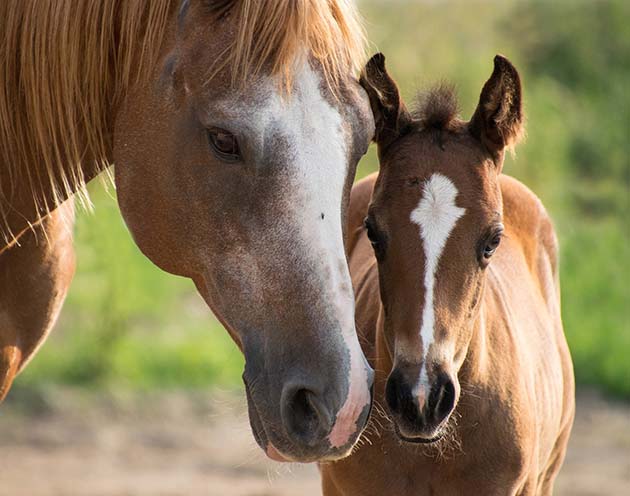
Each horse has a basic colour, which can be black, bay/brown or chestnut. These basic coat colours are controlled by the Extension and Agouti genes. The Agouti gene (A-locus) controls the distribution of black pigment. The pigment can be uniformly distributed or distributed to the “points” of the body (mane, tail, lower legs and inside the ears). The Agouti gene has no effect on horses that are homozygous ee for the Extension gene as black pigment has to be present for agouti to have an effect. The Coat Colour Agouti test (P907) tests for the genetic status of the Agouti gene. The Agouti gene has two variants (alleles). The dominant allele A restricts black pigment to the points of the horse (for example in bays and buckskins) and the recessive allele a uniformly distributes black pigment over the entire body. Only when the horse has two copies of the recessive allele a (homozygous aa), the black pigment is evenly distributed. The black pigment is distributed into the points if at least one copy of the allele A is present. All horses, regardless of their coat colour do have the genetics for the distribution of black pigment, but it’s not always physically visible.

The Coat Colour Agouti test encloses the following results, in this scheme the results of the Coat Colour Agouti test are shown in combination with the possible results for the Coat Colour Chestnut test:

Result Agouti

Result Chestnut

Coat Colour

Description

a/a

E/E or E/e

Black

Only the recessive allele a was detected. The black pigment is distributed uniformly. If the horse is not e/e for the Extension gene, the basic colour is black unless modified by other colour modifying genes. It can only pass on allele a to its offspring.

a/a

e/e

Chestnut, Sorrel

Only the recessive allele a was detected. The black pigment is distributed uniformly. Because the horse is e/e for the Extension gene, the basic colour is chestnut or sorrel unless modified by other colour modifying genes. It can only pass on allele a to its offspring.

A/a

E/E or E/e

Bay, Brown

The horse is tested heterozygous for Agouti. The black pigment is distributed into the points. If the horse is not e/e for the Extension gene, the basic colour is bay or brown unless modified by other colour modifying genes. It can pass on either allele A or a to its offspring.

A/a

e/e

Chestnut, Sorrel

The horse is tested heterozygous for Agouti. The black pigment is distributed into the points. Because the horse is e/e for the Extension gene, the basic colour is chestnut or sorrel unless modified by other colour modifying genes. It can pass on either allele A or a to its offspring.

A/A

E/E or E/e

Bay, Brown

Only the dominant allele A was detected. The black pigment is distributed into the points. If the horse is not e/e for the Extension gene, the basic colour is bay or brown unless modified by other colour modifying genes. It can only pass on allele A to its offspring and therefore cannot produce black foals.

A/A

e/e

Chestnut, Sorrel

Only the dominant allele A was detected. The black pigment is distributed into the points. Because the horse is e/e for the Extension gene, the basic colour is chestnut or sorrel unless modified by other colour modifying genes. It can only pass on allele A to its offspring and therefore cannot produce black foals.

Grey

A horse that inherits a Grey coat colour can be born in any colour. The grey gene causes progressive depigmentation (fading) of the hair and is considered to be the “strongest” of all coat colour modifying genes. The depigmentation process may last for years, but once the hair is depigmented, the original colour will never return. Some grey horses become completely white whereas others will keep tiny non-faded spots (also called fleabites). A horse can also carry mutations for other modifying genes which can further affect its coat colour.

The Coat Colour Grey test (P807) tests for the genetic status of the STX17 gene. This gene has two variants (alleles). The dominant allele G results in the Grey coat colour and the recessive allele N does not have an effect on the basic colour. The dominant allele G has a duplication of a part of the DNA. The test does not discriminate between horses carrying 1 or 2 copies of  the duplication (N/G or G/G). All horses carrying the duplication will turn grey.

The Coat Colour Grey test encloses the following results, in this scheme the results of the Coat Colour Grey test are shown in combination with the possible results for the tests that determine the basic Coat Colour (Coat Colour Chestnut and Coat Colour Agouti test):

Result Grey

Result Chestnut + Agouti

Coat Colour

Description

N/N

e/e + A/A, A/a or a/a


Chestnut, Sorrel

Horse will not turn grey. The basic colour chestnut/sorrel is not modified unless modified by other colour modifying genes. It can only pass on allele N to its offspring.

N/N

E/E or E/e + A/A or A/a

Bay, Brown

Horse will not turn grey. The basic colour bay/brown is not modified unless modified by other colour modifying genes. It can only pass on allele N to its offspring.

N/N

E/E or E/e + a/a

Black

Horse will not turn grey. The basic colour black is not modified unless modified by other colour modifying genes. It can only pass on allele N to its offspring.

N/G or G/G

e/e + A/A, A/a or a/a


Grey (born chestnut/sorrel)

Horse is born with basic colour chestnut/sorrel (unless modified by other colour modifying genes) and will turn grey. One copy or two copies of the G allele. It can pass on either allele N or G to its offspring.

N/G or G/G

E/E or E/e + A/A or A/a

Grey (born bay/brown)

Horse is born with basic colour bay/brown (unless modified by other colour modifying genes) and will turn grey. One copy or two copies of the G allele. It can pass on either allele N or G to its offspring.

N/G or G/G

E/E or E/e + a/a

Grey (born black)

Horse is born with basic colour black (unless modified by other colour modifying genes) and will turn grey. One copy or two copies of the G allele. It can pass on either allele N or G to its offspring.

Overo-factor (OLWS)

The Overo coat pattern is a white spotting pattern with white patches on the side with a “frame” of colour surrounding the white. A horse can also carry mutations for other modifying genes which can further affect its coat colour. While Overo coloured horses are desirable, the mutation that causes the overo colour is linked to a fatal condition known as Overo Lethal White Syndrome or OLWS. A foal with OLWS is born all- white and dies of complications from intestinal tract abnormalities. The Coat Colour Overo test (P902) tests for a genetic factor that affects the function of the EDNRB gene. This gene has two variants (alleles). The allele O is semi-dominant. One copy of the O allele results in horses with overo coat pattern. Two copies of the O allele result in a lethal white foal (OLWS). The allele N is recessive and does not have an effect on the basic colour.

The Coat Colour Overo-factor test encloses the following results, in this scheme the results of the Coat Colour Overo-factor test are shown in combination with the possible results for the tests that determine the basic Coat Colour (Coat Colour Chestnut and Coat Colour Agouti test):

Result Overo-factor

Result Chestnut + Agouti

Coat Colour

Description

N/N

e/e + A/A, A/a or a/a


Chestnut, Sorrel


Not Overo. The basic colour chestnut/sorrel is not modified unless modified by other colour modifying genes. It can only pass on allele N to its offspring.

N/N

E/E or E/e + A/A or A/a

Bay, Brown

Not Overo. The basic colour bay/brown is not modified unless modified by other colour modifying genes. It can only pass on allele N to its offspring.

N/N

E/E or E/e + a/a

Black

Not Overo. The basic colour black is not modified unless modified by other colour modifying genes. It can only pass on allele N to its offspring.

N/O

e/e + A/A, A/a or a/a


Chestnut/sorrel overo

Overo pattern. One copy of the O allele. The horse has the desirable frame overo pattern unless modified by other colour modifying genes. It can pass on either allele N or O to its offspring.

N/O

E/E or E/e + A/A or A/a

Brown/bay overo

Overo pattern. One copy of the O allele. The horse has the desirable frame overo pattern unless modified by other colour modifying genes. It can pass on either allele N or O to its offspring.

N/O

E/E or E/e + a/a

Black overo

Overo pattern. One copy of the O allele. The horse has the desirable frame overo pattern unless modified by other colour modifying genes. It can pass on either allele N or O to its offspring.

O/O

Any result

Lethal (OLWS)

Foal with Overo Lethal White Syndrome (OLWS), lethal.

Combibreed Health Package for Cats – K500

Découvrez les secrets de l’ADN de votre chat bien-aimé!

Plongez dans le monde fascinant de l’ADN de votre compagnon félin grâce à notre kit complet. Découvrez le monde captivant de leur ADN, qui vous donnera des informations précieuses sur leur santé et leurs traits distinctifs.

Explorer plus de 85 traits et conditions de santé

Nos tests avancés vont au-delà de la surface, identifiant 85 traits et conditions génétiques clés de santé. Notre test complet garantit que vous pouvez offrir les meilleurs soins à votre compagnon félin bien-aimé.

Délai de livraison: 15-20 jours ouvrables

€ 99,95 TVA incluse

€ 82,60 Hors TVA

Modifiez la quantité dans votre panier si vous souhaitez commander plusieurs paquets.

Qu’est-ce qui est inclus?

Conditions de santé: Gardez votre chat en bonne santé et heureux grâce à un examen approfondi. Détectez rapidement tout problème de santé d’origine génétique afin d’assurer son bien-être à long terme et même de planifier sa reproduction.

Traits génétiques: Découvrez ce qui rend votre chat unique. Découvrez la couleur, la longueur et les motifs de son pelage grâce à notre test ADN, qui explore les gènes qui définissent son apparence.

Nous maintenons un taux de réussite de 95 % pour la livraison du rapport de santé final.

Plus d’informations? Cliquez ici pour consulter nos FAQ.

Dernière mise à jour 21.08.2025.

Comment cela fonctionne-t-il?

combibreed testen

Commandez en quelques clics!

Ajoutez le CombiBreed Health Package for Cats à votre panier et indiquez vos coordonnées et celles de votre chat. Ces informations faciliteront le traitement de votre commande et feront partie de votre rapport de santé complet. Nouveau chez CombiBreed? Créez un compte pour accéder aux résultats des tests sur notre portail en ligne et obtenir des informations sur la santé de votre chat.

Recueillir du matériel ADN

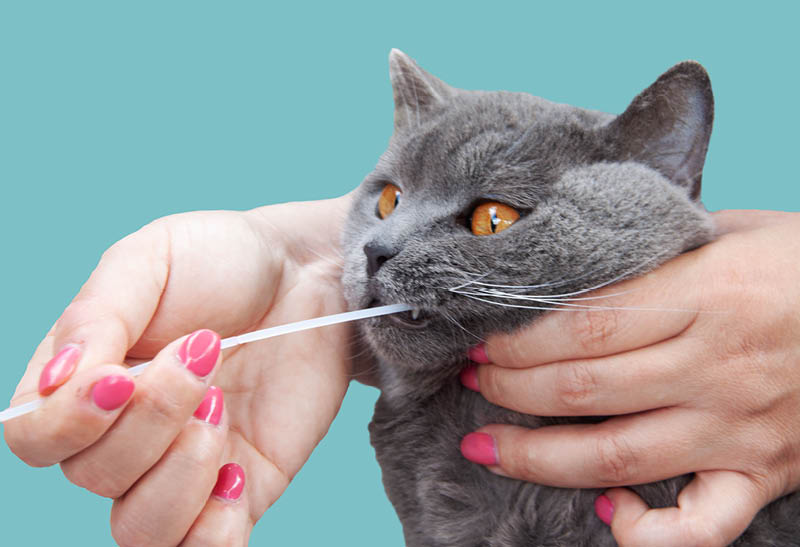
Suivez le guide étape par étape fourni dans notre kit de prélèvement, qui comprend 2 écouvillons. Il s’agit d’un processus rapide que vous pouvez effectuer à la maison. Emballez vos écouvillons en toute sécurité et envoyez-les à notre laboratoire. Veillez à ce que chaque prélèvement soit étiqueté avec le nom de votre chat et son numéro de puce ou d’enregistrement afin de garantir un traitement précis.

Analyse ADN

Nos experts traitent les données génétiques de votre chat avec le plus grand soin, en veillant à ce que chaque détail soit méticuleusement examiné. Nous allons plus loin pour garantir la fiabilité. Nos contrôles de qualité rigoureux sont conçus pour vous fournir des résultats fiables.

Résultats disponibles

Nous vous informerons par courrier électronique lorsque vos résultats seront prêts à être consultés sur le portail en ligne de CombiBreed. Une fois qu’au moins 50 % des résultats sont disponibles, vous pouvez vous connecter à votre compte pour accéder à ces informations précieuses. Une fois tous les tests terminés, vous recevrez par e-mail le rapport de santé complet de votre chat au format PDF.

Foire aux questions (FAQ)

Pourquoi devrais-je envisager un test ADN pour mon chat?

Les tests ADN peuvent révéler des informations cruciales sur la santé de votre chat, les traits spécifiques à sa race et les risques génétiques potentiels. Ces informations vous permettent de prendre des mesures proactives pour assurer leur bien-être général et leur longévité.

Quelle est la différence entre les paquets CombiBreed spécifiques à une race et le paquet santé CombiBreed pour les chats?

Les kits CombiBreed ont été conçus pour de nombreuses races de chats. Les tests qu’ils contiennent sont tous adaptés à la race. Le pack “Santé” contient de nombreux tests pertinents pour les races courantes. Vous souhaitez uniquement connaître les conditions de santé génétiques de votre race ? Dans ce cas, nous vous conseillons d’acheter un kit spécifique à votre race.

Qu’entend-on par “tests ADN pertinents à la race”?

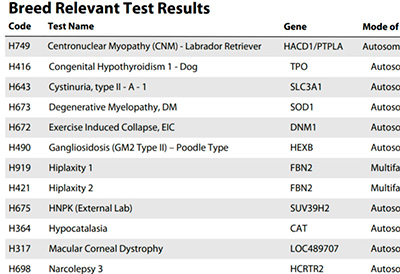
Tous les tests ADN ne sont pas adaptés à toutes les races. Les races pour lesquelles le test est adapté sont décrites sur la page produit de chaque test. Dans le rapport du CombiBreed Santé pour chats, nous distinguons également les tests pertinents pour la race et les autres tests en fonction des données que vous avez saisies lors de l’achat.

Comment puis-je savoir que vous avez reçu l’échantillon de mon chat?

Vous recevrez un courriel de confirmation lorsque nous aurons reçu l’échantillon de votre chat dans notre laboratoire. Ce courriel vous donnera l’assurance que l’échantillon a bien été reçu et qu’il est entre nos mains.

Quelles sont les précautions à prendre avant de collecter du matériel génétique?

Pour garantir la qualité des échantillons, il est recommandé de préparer votre chat 1 à 2 heures avant le prélèvement. Pendant cette période, gardez votre chat à l’écart des autres animaux et ne lui permettez pas de manger ou de boire, à l’exception de l’eau.

Mes données et celles de mon chat sont-elles en sécurité avec CombiBreed?

Oui, nous prenons la confidentialité des données au sérieux. Vos informations personnelles et celles de votre chat sont traitées avec le plus haut niveau de confidentialité et de sécurité. Veuillez consulter notre politique de confidentialité pour plus de détails.

Puis-je commander plusieurs CombiBreed Santé pour des différents chats?

Absolument ! Vous pouvez commander plusieurs kits de santé CombiBreed pour différents chats et les gérer tous dans votre compte CombiBreed pour un accès pratique à leurs résultats respectifs. Ajoutez le kit à votre panier et gérez la quantité dans ce même panier.

Puis-je communiquer les résultats de mon chat à mon vétérinaire?

Bien sûr ! Le partage des résultats génétiques de votre chat avec votre vétérinaire peut faciliter l’élaboration de plans de soins mieux adaptés. Utilisez pour cela le rapport pdf contenant les résultats. Vous pouvez le communiquer à votre vétérinaire par courrier électronique ou sous forme imprimée.

Le prélèvement d’ADN sur mon chat est-il indolore?

Oui, le prélèvement d’ADN à l’aide du kit d’écouvillonnage est totalement sûr et indolore pour votre chat. Il s’agit d’un processus non invasif qui ne nécessite qu’un écouvillonnage de la joue intérieure.

Combien de temps dois-je attendre que mon chat ait mangé avant de prélever l’échantillon?

Il est recommandé d’attendre 1 à 2 heures après que votre chat ait mangé avant de prélever l’échantillon. Pendant ce temps, gardez-le à l’écart des autres animaux et ne lui donnez que de l’eau.

Puis-je utiliser le kit de santé CombiBreed pour n’importe quelle race de chat?

Le CombiBreed Santé pour chats est conçu pour couvrir toutes les races de chats. Cela signifie que, quelle que soit la race de votre chat, vous pouvez bénéficier des informations génétiques complètes fournies par le kit. Vous obtiendrez des informations précieuses sur la santé de votre chat, les risques génétiques potentiels et d’autres caractéristiques pertinentes, quelle que soit sa race. Ce caractère inclusif fait du kit ADN santé une ressource polyvalente et précieuse pour tous les propriétaires de chats.

Le kit ADN Santé est-il adapté aux chatons?

Oui, le CombiBreed Santé pour chats peut fournir des informations précieuses sur la santé et les risques potentiels des chatons, vous aidant ainsi à établir les bases de leur bien-être.

Pourquoi dois-je envoyer deux écouvillons de mon chat?

Compte tenu de la gamme étendue de tests ADN inclus dans notre kit de santé CombiBreed pour chats, nous avons besoin d’une plus grande quantité de matériel ADN que pour nos autres tests et kits. Il est donc nécessaire de renvoyer deux écouvillons contenant du matériel ADN. Lors de votre commande, vous recevrez un kit d’écouvillonnage comprenant deux écouvillons et des instructions d’échantillonnage détaillées.

Je n’ai pas reçu les résultats de tous les tests ADN, mais le rapport a déjà été finalisé. Recevrai-je quand même les résultats de ces tests en attente?

L’ensemble comprend plus de 65 tests ADN et il est possible que nous ne soyons pas en mesure de fournir des résultats pour chacun d’entre eux dans un premier temps. Dans les cas où aucun résultat n’est disponible, nous procéderons à un nouveau test pour nous assurer que nous pouvons fournir un résultat. Nous maintenons un taux de réussite de 95 % pour le rapport final de la santé.

Que signifie ‘Aucun résultat’?

Si un test donne ‘Aucun résultat’, nous ne pouvons pas générer un résultat fiable. Cependant, l’échantillon est de qualité suffisante pour générer un résultat fiable pour les autres tests. La fiabilité du test effectué est déterminée par des analyses répétées. Si les résultats diffèrent les uns des autres, nous ne pouvons pas rapporter un résultat fiable. Un ‘aucun résultat’ peut également se produire parce qu’un certain test n’obtient pas de résultat, alors que des tests effectués en parallèle fournissent un résultat fiable. Si vous désirez toujours un résultat pour ce test, vous pouvez le racheter dans notre boutique en ligne et envoyer un nouvel échantillon.

Comment saurai-je si j’ai recueilli suffisamment de matériel génétique pour l’analyse?

Même si vous ne voyez pas de matériel génétique visible sur les écouvillons, si vous avez suivi les instructions, vous avez probablement recueilli une quantité suffisante d’ADN. Notre laboratoire effectue des contrôles de qualité afin de garantir une quantité suffisante de matériel génétique pour l’analyse.

Comment puis-je rester informé de l’état d’avancement de ma commande?

Vous recevrez des notifications par courrier électronique à des étapes clés du processus, par exemple lorsque vos échantillons sont reçus, lorsque les résultats sont prêts à être consultés et lorsque votre rapport de santé complet est disponible.

Puis-je prélever les échantillons moi-même ou ai-je besoin de l’aide d’un professionnel?

Vous pouvez facilement prélever les échantillons vous-même en suivant les instructions fournies dans le kit de prélèvement. Le processus est conçu pour une utilisation à domicile.

Comment recevrai-je les résultats de mes tests?

Une fois que nous aurons reçu vos échantillons et que nous les aurons analysés, nous vous avertirons par e-mail que vos résultats sont prêts. Connectez-vous à votre compte CombiBreed pour accéder à vos résultats sur le portail en ligne. Un rapport de santé complet vous sera envoyé par e-mail lorsque tous les tests demandés auront été effectués.

Comment accéder à votre portail en ligne?

Vous pouvez accéder à notre portail en ligne via votre compte dans notre boutique en ligne CombiBreed. Cliquez sur “Portail en ligne” dans le menu de votre compte personnel. La première fois, nous vous demandons de vous connecter à nouveau pour vérifier l’identité de l’utilisateur. La prochaine fois, vous pouvez cliquer directement sur le lien et vous arriverez immédiatement sur notre portail en ligne.

Oculoskeletal Dysplasia (OSD) / Retinal Dysplasia (RD) – Northern Inuit Dog

Dogs with Ocular Skeletal Dysplasia (OSD) show a variety of skeletal malformations, which are caused by a recessive mutation to the gene COL9A3. A related variant also occurs in the Labrador Retriever.OSD is often accompanied with eye abnormalities, which also is the case in the Nothern Inuit Dog. These eye abnormalities are caused by a collagen disorder called Retina Dysplasia (RD) or Retinal Folds.

Primary Open Angle Glaucoma (POAG) – Petit Basset Griffon Vendéen

Primary Open Angle Glaucoma (POAG) is an inherited eye condition characterized by a gradual, sustained increase in intraocular pressure due to impaired drainage of fluid within the eye. This variant of the disease, caused by a recessive mutation in the ADAMTS17 gene, occurs in the Petit Basset Griffon Vendéen.

Similar variants have also been identified in the Basset Fauve de Bretagne, Basset hound, and the Chinese Shar-Pei.

Commande

Produits

Dans notre boutique en ligne CombiBreed, vous pouvez commander des tests ADN pour chiens, chats et chevaux. Sélectionnez la bonne espèce d’animale pour la gamme de tests ADN disponibles et applicables. Notre outil de sélection vous aidera à sélectionner les bons tests ADN. Trois options s’offrent à vous:

  • Essai unique; commandez un seul test pour votre animal (tous les types possibles)
  • Paquet CombiBreed; nous avons fait des paquets pour de nombreuses races avec l’aide de clubs de race et de livres généalogiques.
  • Créez votre propre package; Voulez-vous combiner des tests ADN dans un emballage pour votre animal? Ensuite, vous pouvez facilement créer votre propre paquet. Utilisez l’outil de sélection pour afficher facilement les tests pertinents pour votre anima

Types de produits

Dans notre boutique en ligne, nous distinguons différents types de produits:

Vérification de la parenté
La vérification de la parenté est basée sur la comparaison des informations génétiques issues de la progéniture, de la mère et du père.

Maladies Génétiques
Les maladies génétiques désignent les troubles génétiques chez les animaux.

Caractères génétiques
Trait génétique fait référence aux caractéristiques externes d’un animal telles que les couleurs de la robe et les variantes du pelage.

Typage Sanguin
Nos tests de typage sanguin ne sont disponibles que pour les chats. Nous proposons à la fois des tests ADN et sérologiques.

Tests de Laboratoire Partenaires
Les tests de laboratoire partenaires sont brevetés dans certains pays. Ces tests seront transmis à un laboratoire partenaire en territoire non breveté.

Outil de sélection
À l’aide de l’outil de sélection, vous pouvez filtrer les tests qui vous concernent. Tous les tests ADN liés aux maladies génétiques sont dans de nombreux cas développés pour des races spécifiques. Cela signifie que les tests ADN sont pertinents pour une ou plusieurs races. Un certain nombre de tests ADN conviennent à toutes les races.

Comment puis-je commander des tests ADN?

Étape 1 : ajouter des produits
Lorsque vous avez trouvé un produit dans notre boutique en ligne, ajoutez-le. Vous pouvez toujours trouver votre panier dans le coin supérieur droit, de sorte que vous pouvez toujours voir ce que vous avez acheté. Vous ne souhaitez pas commander le produit ? Les produits sont faciles à retirer de votre panier.

Étape 2: remplissez les informations personnelles
Pour passer une commande, vous devez créer un compte. Ceci est nécessaire car les résultats des tests ADN seront disponibles dans votre compte. Gardez donc vos informations de connexion en sécurité! Lors de la création d’un compte, vous pouvez entrer vos données personnelles. Avez-vous déjà un compte? Ensuite, connectez-vous avec vos coordonnées. Les données peuvent être modifiées à tout moment.

Étape 3 : données animales
Afin de pouvoir effectuer les tests ADN et reconnaître le matériel ADN, nous avons besoin des données de l’animal/des animaux. Entrez les détails de votre animal, tels que le numéro d’identification unique et le nom. Ces données des animaux sont également indiquées sur le(s) rapport(s). Une fois la commande traitée, les données des animaux ne peuvent plus être modifiées. Soyez donc prudent lors de la saisie des données de vos animaux. Avez-vous commandé plusieurs produits? Vous pouvez entrer les données de l’animal pour chaque test ou emballage.

Étape 4: vérifier la commande et payer
Avant de passer et de payer la commande, nous vous demandons de bien vouloir vérifier à nouveau la commande. Si vous avez des questions, veuillez contacter notre service client. Sélectionnez le mode de paiement souhaité, nous vous proposons différentes options. Une fois le paiement reçu par nous, nous traiterons votre commande.

Étape 5: expédition du kit ADN & de l’échantillonnage
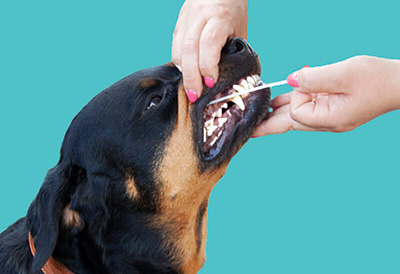
Après réception de la commande, vous recevrez un kit d’écouvillon pour chiens et chats. Ce kit d’écouvillon contient des instructions pour enlever la muqueuse buccale à l’aide de l’écouvillon. Nous aimons recevoir des poils pour effectuer des tests ADN pour les chevaux. Notez que ces poils contiennent des racines de cheveux, car nous ne sommes pas en mesure d’extraire l’ADN d’échantillons de cheveux qui ne contiennent pas de racines de cheveux.

Votre compte de boutique en ligne

Avez-vous déjà un profil dans notre boutique en ligne? Ensuite, vous pouvez facilement vous connecter via le bouton en haut de la boutique en ligne. Après vous être connecté, vous arriverez dans votre profil. Dans ce profil, vous trouverez vos données personnelles, vos données de vos animaux et les résultats des tests.

Déficit en facteur VII

Canine Coagulation Factor VII is an important protein involved in blood clotting in dogs. Deficiency in Factor VII causes a bleeding disorder, which can lead to dangerously uncontrolled bleeding in the case of injury or surgery. The disorder occurs in a wide range of breeds, including the Airedale Terrier, Beagle, German Wirehaired Pointer and Scottish Deerhound. It is caused by a recessive mutation to the gene F7.

Blood Types Cat – K300 / K712 / K793

Background
For cats different kinds of blood types exist, of which the AB-system is the most important one. In this system, cats can have an A, B or AB blood type.
The presence of naturally occurring high amounts of anti-A antibodies in type B cats, leads to the bursting of type A red blood cells when they get into contact with type B blood. This is for example the case in neonatal isoerythrolysis (NI). NI can occur when a queen with blood type B is bred to a tom with blood type A, giving birth to kittens with blood type A. When drinking colostrum during the first days of life, the kittens absorb the anti-type A antibodies produced by the type B queen. This will lead to the bursting of the kitten’s type A red blood cells, causing anaemia, which can be lethal. It is therefore important for breeders to test the blood type of breeding queens, to identify the risk of NI and minimizing the chances of neonatal mortality.

The genetic tests K793 and K300
Genetic test K793, available for all breeds *, identifies two types of recessive b alleles which are associated with blood type B. By analysing these two mutations together, it is possible to predict the type B blood type in cats. Since additional mutations yet have to be identified, there is a possibility that the genetic results from this test do not match the conventional blood typing results (serology).
Genetic test K300, available for Ragdolls, identifies one variant of the AB allele and is associated with type AB blood in Ragdoll cats. Since blood type AB cats from other breeds do not have the Ragdoll type AB variant which is analysed with the K300 genetic test, at least one other variant must be present that also results in type AB blood in other cat breeds. This variant has yet to be identified.

Serologic test K712
Another method to identify cat blood types, is serology. This method does not give information about the genetic background in a direct way and is therefore not suitable to use as a solely method when making breeding choices. When genetic tests (K300 and/or K793) do give an inconclusive result (type A or AB), the serologic test can be used to make a distinction between type A or type AB blood.
Serologic blood typing is mainly used for blood transfusions and can only be performed on whole blood (EDTA or Heparin).

Interpretation of results
Cats with two copies of any of the two b alleles have type B blood. Cats with one copy of any of the two b alleles and thus carrier of b have either type A or AB blood, depending on which second allele is present.

Ragdolls with two copies of the AB allele have type AB blood. Ragdolls with one copy of the AB allele and thus carrier of AB have either type A type AB blood, depending on which second allele is present.

Please note that it is not possible to distinguish between blood type A or AB with our genetic tests when only test K300 (Ragdoll only) or test K793 is performed. To make a distinction between blood type A or AB, serologic test K712 can be used. For Ragdolls it is advised to perform both K300 and K793 to receive the most accurate result.

Interpretation blood type (all breeds *) – K793

Genetic result Genotype Interpretation
No b allele N/N Cat has blood type A or AB **
One copy of one of the two b alleles N/b Cat has blood type A or AB **
Two copies of any of the two b alleles b/b Cat has blood type B
Inconclusive Blood type cannot be determined, cat has blood type A, B or AB. Serologic test K712 can give additional information.

Interpretation blood type (Ragdoll) – K300

Genetic result Genotype Interpretation
No AB alleles N/N Cat has blood type A or B ***
One copy of the AB allele N/AB Cat has blood type A or AB **
Two copies  of the AB allele AB/AB Cat has blood type AB

Interpretation blood type (Ragdoll) – K300 and K793 combined

Result K300 Result K793 Interpretation
N/N N/N Cat has blood type A
N/AB N/N Cat has blood type A
AB/AB N/N Cat has blood type AB
N/N N/b Cat has blood type A
N/AB N/b Cat has blood type AB
N/N b/b Cat has blood type B

* Some breeds like Siamese, Burmese and Oriental Shorthair do not have the b allele

** Please note that it is not possible to distinguish between type A or AB blood with our genetic tests. To make a distinction between blood type A or AB, serologic test K712 can be used to give additional information.

*** Please note that is not possible to distinguish between type A or B blood with only genetic test K300 in Ragdolls, genetic test K793 can be used to give additional information.

Cookies

COOKIES

VHLGenetics uses cookies to recognise you if you visit our websites. Cookies are bits of data which your browser stores on your computer, and which enable us to gather information about how people use our services so we can improve them and adapt them to suit your wishes. Our cookies provide details of personal identification. You can set your browser not to accept cookies.

We will inform you about the cookies law on this page as well and clearly as we can.

What are cookies?

Cookies are very small text files which are stored on your hard drive or in your computer’s memory. They are linked to the web browser (Explorer, Chrome, Firefox, Safari, etc.) on the computer you use to visit a website.

What do cookies do?

Cookies can be used to save your personal preferences, like language settings or font sizes, to remember what products you put in your shopping basket at a webshop or let you log in to a website faster by remembering your user name and pre-entering it.

Websites also use cookies to gather statistics about those who visit them, so publishers can see what parts or products are popular or help visitors navigate their way around or see what web browsers or hardware they are using, so publishers can continue improving their websites and tailor their contents to their user groups.

Cookies can also be used to build up a picture of your interests, such as by remembering what kind of articles you read or headings you visit. This helps publishers offer you relevant information, such as extra news articles on subjects in which you showed an interest before or ads which relate to your interests. So publishers can avoid burdening users with irrelevant advertising and ensure you don’t end up seeing the same ads or videos time and time again.

Do cookies tell publishers who I am?

No, definitely not! Cookies are held in your computer’s web browser, and are not linked to you personally: so they can only tell publishers what computers they are dealing with, not who is using them. Nor can cookies be used to get your personal data, like your e-mail or home address. So they have absolutely nothing to do with unwanted sales calls, spam or viruses.

How does VHLGenetics use cookies?

VHLGenetics’s websites (www.vhlgenetics.comwww.snpexpert.comwww.combibreed.com and www.combigen.com) use cookies. Many of these cookies are needed for our sites to work, such as by ensuring you can log in without having to enter your username and password each time.

We use other cookies for statistical purposes, like measuring how often visitors use our sites, what articles they like reading, what web browsers they use and what search terms they enter in their search engines to find our websites, so we can optimise and improve both their form and content. These cookies do not hold personal data, so they do not record who you are or what your e-mail address is.

Lastly, our sites also use cookies for advertising purposes. These cookies don’t record any personal data either, and are linked to your browser, not to you yourself. We use these cookies to use to match our websites to your interests as far as possible, and sometimes to remember that you’ve seen an ad already. So we can ensure visitors don’t see the same statements, time and time again.

Why should I allow cookies? 

Cookies help VHLGenetics improve our websites constantly. We use the users’ statistics we gather to improve our users’ experience and the quality of the content of our sites.

VHLGenetics’ websites could not work without cookies, in a number of ways. We use them to let you log in, for instance. If you disable cookies, some parts of our websites won’t work well any longer.

How can I reject cookies, though?

You can opt to delete cookies from your web browser’s settings completely, or only allow cookies which are offered by the website you are visiting at the time, so third party cookies will be blocked.

Either way, these settings don’t then just apply to VHLGenetics’ websites, but to the Internet as a whole; and your settings will always be linked to your web browser. So you need to tell each browser and each computer you use what you want.

Déficit en dihydropyrimidinase

Dihydropyminidase (DHP) is an enzyme involved in essential metabolism. The DHP enzyme is involved in various metabolic pathways, including the breakdown of pyrimidine bases (uracil and thymine) as well as certain drugs. The mutation in the DPYS gene, causes the DHP enzyme substrate to accumulate without producing the active protein. This leads to a DHP deficiency in the body causing tiredness, weakness, vomiting, and high levels of ammonia in the blood particularly while on a high-protein diet. The extremely rare recessive mutation causing this specific version of the disorder was discovered in a Japanese cat around the early 2000s.

Chestnut

Each horse has a basic colour, which can be black, bay/brown or chestnut. These basic coat colours are controlled by the Extension and Agouti genes. The Extension gene (E-locus) controls the production of black and red pigment. The Coat Colour chestnut test (P904) tests for the genetic status of the Extension gene. The Extension gene has two variants (alleles). The dominant allele E produces black pigment and the recessive allele e produces red pigment. All horses, regardless of their coat colour do have the genetics for black or red pigment. Red horses (for example chestnut, sorrel, palomino and cremello) have two copies of the recessive allele e, also called homozygous ee. Black pigmented horses (for example black, bay, brown, smoky black, buckskin, smoky cream and perlino) have at least one copy of the allele E. They can be homozygous EE or heterozygous Ee.

The Coat Colour Chestnut test encloses the following results, in this scheme the results of the Coat Colour Chestnut test are shown in combination with the possible results for the Coat Colour Agouti test:

Result Chestnut

Result Agouti

Coat Colour

Description

e/e

A/A, A/a or a/a

Chestnut, Sorrel

Only the recessive allele e was detected, the horse is homozygous for red pigment (ee). The basic colour is chestnut or sorrel unless modified by other colour modifying genes. It can only pass on allele e to its offspring.

E/e

a/a

Black

The horse is heterozygous for red pigment (Ee). The basic colour is black unless modified by other colour modifying genes. It can pass on either allele E or e to its offspring.

E/e

A/A or A/a

Bay, Brown

The horse is heterozygous for red pigment (Ee). The basic colour is bay or brown unless modified by other colour modifying genes. It can pass on either allele E or e to its offspring.

E/E

a/a

Black

Only the dominant allele E was detected, the horse is homozygous for black pigment (EE). The basic colour is black unless modified by other colour modifying genes. It can only pass on allele E to its offspring and therefore cannot produce red foals.

E/E

A/A or A/a


Bay, Brown

Only the dominant allele E was detected, the horse is homozygous for black pigment (EE). The basic colour is bay or brown unless modified by other colour modifying genes. It can only pass on allele E to its offspring and therefore cannot produce red foals.

Interpretation Testresults

Availability of DNA tests

Nowadays, scientific articles do not often publish mutations that are also present in other breeds. Therefore, mutations that are described and validated in one breed can also be found in other breeds. The occurrence of these mutations in other breeds is determined by laboratories that carry out the tests. It is difficult to estimate how high the reliability is for a certain test for a particular breed.

The above basis applies in general to hereditary diseases. Hereditary diseases are passed on from one generation to another through defective genes. Nevertheless, inheritance of a disease remains a biological process, and therefore exceptions are still possible. The specific information for a test gives more information about possible deviations.

Our tests do not make recommendations on breeding decisions

Our DNA tests offer you insight into the composition of your animal’s DNA. If possible, we will try to inform you of the optimal choice of tests for your personal situation. You should be aware that our laboratories are not responsible for the breeding decisions that you take. This is due to the complexity of the variation in tests and breeds. We recommend that, for advice concerning breeding decisions, you contact your international or national breed association or vet.

Within a combination package, a single result for a DNA test may be missing from the report

It is possible that a low percentage of results may be missing if a combination package is requested this can be caused due to technical reasons. We consider a combination package ‘fully reported’ if only one or two of the markers within a combination package are missing after retesting. No refund will be provided for missing tests within a combination package.

Combination packages are not 100% complete

Our combination packages will never be 100% complete due to the large number of publications in the scientific literature. We update the packages twice a year, whereby we use the following criteria: a) changes to the breeds in which a DNA test has been validated, b) the type of disease and c) technical criteria.

There is never a fool-proof link between test results and disease symptoms

In general, our tests are based on scientific publications. In these articles, a disease or condition is described with detailed information about the symptoms and background of the DNA test. The test does not guarantee that the animal still has the possibility to develop symptoms. The symptoms can be caused due to unknown genetic mutations. However, after testing positive for a disease an animal will not always develop symptoms. We therefore recommend that you contact your local or international breed association, Management Board or vet for breeding or veterinary advice.

Macchiato (Splashed White)

In 2008 a colt with a striking white-spotting coat colour was born out of two solid-coloured bay Franches-Montagnes parents. The coat colour looks like a combination of white-spotting and coat colour dilution and it was named ‘‘macchiato’’. A clinical examination revealed that the macchiato stallion was deaf and had a low progressive sperm motility.

The Coat Macchiato (Splashed White)  test (P593) tests for a mutation in the MITF gene. This test detects two variants (alleles). The allele M is dominant. One or two copies of the M allele result in the Macchiato coat colour. The allele N is recessive and does not have an effect on the basic colour.

The Coat Macchiato (Splashed White) test encloses the following results:

Result Macchiato

Coat Colour

Description

N/N

Non-Macchiato


Non-Macchiato. The basic colour is not modified unless modified by other colour modifying genes. It can only pass on allele N to its offspring.

N/M

Macchiato

Macchiato pattern. One copy of the M allele. Horse has Macchiato coat pattern unless modified by other colour modifying genes. It can pass on either allele N or M to its offspring.

M/M

Macchiato

Macchiato pattern. Two copies of the M allele. Horse has Macchiato coat pattern unless modified by other colour modifying genes. It can only pass on allele M to its offspring.

Myeloperoxidase Deficiency

Myeloperoxidase Deficiency (MPOD) is a disorder affecting white blood cells, observed in the Italian Hound (e.g. Italian Greyhound, Segugio Italiano). It is caused by a recessive mutation to the gene MPO.

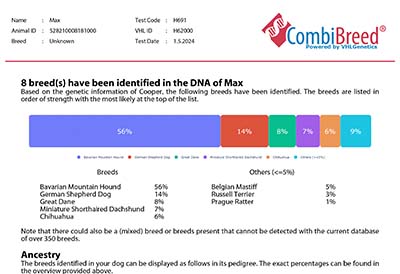
CombiBreed Breed Identification for Dogs – H691

What breeds make up your dog?

Every dog is unique! The CombiBreed Breed Identification test uncovers the unique mix of breeds in your dog.

While you’re likely curious about your dog’s origins, understanding their ancestry can be incredibly valuable. A dog’s lineage can reveal potential health risks, influence their behaviour, and explain physical traits inherited from various breeds. With this insight, you’ll be better equipped to provide tailored care, training, and medical attention, ensuring your dog’s needs are met based on their specific genetic makeup.

Delivery time: 30 business days

€ 119,79 incl. VAT

€ 99,00 excl. VAT

Modify the quantity in your shopping cart if you wish to order multiple tests.

What’s included?

Ancestry: Get a comprehensive breakdown of your dog’s ancestry.

MDR1 Multi Drug Resistance: Multidrug resistance 1 (MDR1), also known as Ivermectin Sensitivity, is a condition characterized by a defect in the blood-brain barrier, potentially resulting in adverse reactions to certain medications. The DNA-test for MDR1 Multi Drug Resistance is included in the CombiBreed Breed Identification test.

Certificate: Receive a Breed Certificate of your dog.

More information? Click here for our FAQs.

How does it work?

combibreed testen

Order in just a few clicks

Add the CombiBreed Breed Identification for Dogs to your cart, and provide your and your dog’s details. This info aids in processing your order and will be part of your comprehensive breed certificate. New to CombiBreed? Create an account for test result access in our online portal, unlocking insights into your dog’s genetics.

Collect DNA material

Follow the step-by-step guide provided in our swab kit, which includes 1 swab. It’s a quick process that you can perform at home. Pack your swab securely and send it to our laboratory. Ensure the swab is labeled with your dog’s name and chip or registration number to guarantee accurate processing.

DNA analysis

Our experts handle your dog’s genetic data with the utmost care, ensuring that every detail is meticulously examined. We go the extra mile to ensure reliability. Our rigorous quality checks are designed to provide you with results you can trust.

Results available

We’ll notify you via email when your results are ready. You’ll receive the CombiBreed Breed Identification of your dog in a PDF via email.

Frequently Asked Questions (FAQ)

How will I receive my test results?

Once we receive your samples and analyse them, we’ll notify you via email when your results are ready. Log in to your CombiBreed account to access your results on the online portal. A complete health report will be emailed to you when all requested tests have results.

Can I collect the samples myself, or do I need professional assistance?

You can easily collect the samples yourself using the instructions provided in the swab kit. The process is designed for at-home use.

Is the CombiBreed Breed Identification suitable for puppies?

DNA tests can be done at any age, including for puppies, as breed-related DNA markers do not change over time.

Is the CombiBreed Breed Identification test reliable?

The CombiBreed Breed Identification test compares your dog’s DNA to a database of over 350 known breeds, ensuring a reliable identification for breeds included in the database. If you suspect your dog may belong to a rare or new breed, please contact us to confirm whether that breed is represented. The accuracy of identifying breeds present in the database is high, providing dependable insights into your dog’s genetic makeup.

Can I use the CombiBreed Breed Identification to confirm my dog is purebred?

The CombiBreed Breed Identification test is designed to reveal the ancestry of your dog but is not intended to confirm whether your dog is a purebred. It provides insights into the mix of breeds present, but this test is not suitable for official confirmation of purebred status.

Do you have an example of the result report of the Breed Identification test for dogs?

Our Breed Identification test for dogs (test number H691) is only available in English. Click here for an example of the result report.

Do you offer Breed Identification tests for horses or cats?

Unfortunately we are yet not able to offer reliable Breed Identification tests for horses or cats. We do offer Breed Identification tests for dogs.

Expédition & livraison

État de la commande

Après vous être connecté à votre compte personnel via « Mon compte », vous pouvez toujours suivre l’état (de vos tests achetés) sous « Mes commandes ». Lorsque le(s) test(s) est(sont) terminé(s), les résultats seront affichés sous ‘Mes commandes’. De plus, nous vous tiendrons informés de l’état de votre (vos) commande(s) par e-mail.

Retester

Nous croyons qu’il est important que nous fournissions des résultats ADN fiables. Le test sera refait à nos frais si le test ne répond pas à nos exigences de qualité. Nous vous informerons si le test ne répond pas à nos exigences de qualité. Étant donné que nous devons re-effectuer le test ADN, le délai d’exécution augmentera, ce qui signifie que le temps global pour vous de recevoir les résultats prendra un peu plus de temps. Néanmoins, à la fin, vous recevrez les bonnes informations sur vos animaux!

Le résultat d’un essai peut être « H1 » indiqué sur le rapport. Cela signifie que la qualité de l’échantillon a été insuffisante et que nous ne pouvons pas rapporter de résultat. Un nouveau test sera effectué à nos frais. Ce nouveau test sera exécuté avec un nouvel échantillon. Nous vous enverrons gratuitement des échantillons.

Livraison

Vous n’avez pas besoin de rester à la maison pour recevoir le colis, car l’échantillon est suffisamment petit pour tenir dans votre boîte aux lettres. CombiBreed facture 5,95 € de frais d’expédition pour les échantillons.

Services ADN

DNA Services Dog

Chien – Génotypage du génome entier

En ce qui concerne le génotypage BeadChips for Illumina, plusieurs options existent. Grâce à notre collaboration avec Geneseek, nous sommes en mesure de proposer une large gamme de puces, y compris des puces personnalisés et la gamme standard de puces Illumina. De plus, nous pouvons vous proposer un ensemble personnalisé, dédié à vos besoins.

La majorité des Illumina BeadChips sont basés sur un format de 24 échantillons. Pour ce test, il est nécessaire de soumettre une série de 24 échantillons.

Selon la tarification il est possible qu’une répétition du test soit incluse ou non dans le prix. Cela dépend en outre du type d’échantillon, de la qualité et de la quantité de l’échantillon ou de l’ADN soumis. Pour votre information, les puces permettent d’utilisé presque n’importe quel type d’échantillon.

Cheval – Equine SNP70 (GGP)

La puce SNP70 équine est une puce dense qui couvre le génome entier du cheval avec 65 000 SNP régulièrement espacés. La puce est un outil approprié pour permettre l’identification des gènes et des polymoprhismes qui contribuent aux traits d’intérêt de toutes les principales races de chevaux.

En ce qui concerne le génotypage BeadChips for Illumina, plusieurs options existent. Grâce à notre collaboration avec Geneseek, nous sommes en mesure de proposer une large gamme de puces, y compris des puces personnalisés et la gamme standard de puces Illumina. De plus, nous pouvons vous proposer un ensemble personnalisé, dédié à vos besoins.

La majorité des Illumina BeadChips sont basés sur un format de 24 échantillons. Pour ce test, il est nécessaire de soumettre une série de 24 échantillons.

Selon la tarification il est possible qu’une répétition du test soit incluse ou non dans le prix. Cela dépend en outre du type d’échantillon, de la qualité et de la quantité de l’échantillon ou de l’ADN soumis. Pour votre information, les puces permettent d’utilisé presque n’importe quel type d’échantillon.

DNA Services Horse

DNA profile Horse – Icelandic Horse

This product contains a DNA profile for a single horse.
A DNA profile is established using DNA markers. The profile from each sample is stored in a database and can be represented as a barcode, which is unique to each individual. This DNA profile serves the purpose of parentage verification, involving a comparison of the genetic information present in an offspring with that of the potential parents. For accurate parentage verification, all genetic information in the offspring must be traceable to the combination of the dam and the sire. In the majority of cases, the reliability of this analysis exceeds 99.5 percent.
In addition to parentage verification, a DNA profile can be employed to confirm the identity of an individual. The reliability of such an analysis is extremely high, as it necessitates an exact match of all genetic information between two samples.

Go to Top